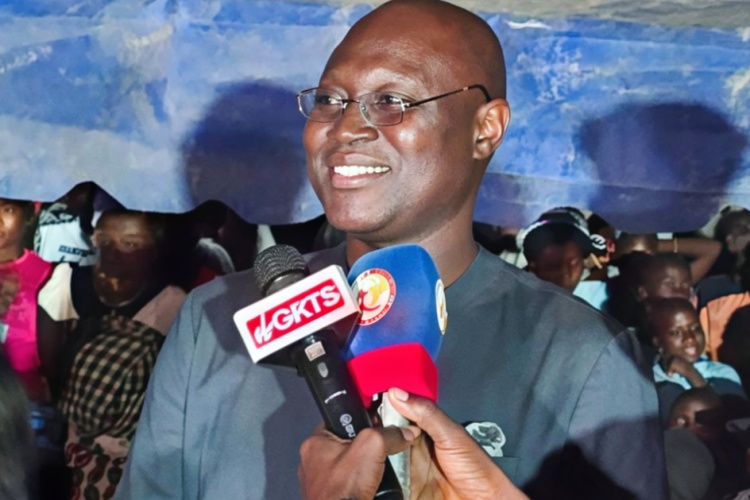
Gambiaj.com – (BANJUL, THE GAMBIA) – The withdrawal of Modou Lamin Sima from The Gambia’s December 5 presidential election has introduced fresh uncertainty into the opposition landscape, raising questions about the political direction of his Alliance of Progressive Citizens (APC) and whether the party intends to remain independent or align itself with another contender.
The Independent Electoral Commission (IEC) announced on Wednesday, November 25, that Sima had formally withdrawn his candidacy on November 24. The withdrawal was accepted by IEC Chairman and Returning Officer Joseph Colley in accordance with Section 50 (2) (a) of the Elections Act 2025.
The decision comes less than two weeks after the IEC cleared Sima to contest the election. He was among nine candidates whose nominations were accepted at the end of the nomination process on November 14.
Neither Sima nor the APC has publicly explained the reasons behind the withdrawal. The party has also not indicated whether it intends to endorse another presidential candidate, leaving its political intentions unclear as the campaign enters its final stretch.
An Alternative Political Project Interrupted
Sima entered the presidential race presenting himself as an alternative to the country’s established political leadership, with an economic program centered on domestic production, employment creation and investment in key sectors.
His campaign placed particular emphasis on reducing The Gambia’s dependence on imported food through agricultural mechanization, increased investment in farmers and the expansion of local production.
He also identified youth and women’s access to finance, entrepreneurship and export development as priorities, arguing that economic transformation required greater opportunities for Gambians to participate in productive activities.
An investor in the Gambian health sector and a former public service employee of the Social Security and Housing Finance Corporation (SSHFC), Sima also made healthcare delivery and unemployment central to his political message. He pledged to improve access to hospital beds, medicines and medical equipment.
His entry into frontline politics followed what he described as frustration that his economic proposals were not attracting sufficient attention through advocacy outside electoral politics.
His withdrawal therefore raises questions not only about the immediate future of his campaign but also about what happens to the political and economic agenda he sought to advance through the APC.
Whether the party intends to continue promoting that agenda independently or pursue it through an alliance with another political movement remains unclear.
Opposition Candidates Could Benefit From An Endorsement
The most immediate political consequence of Sima’s withdrawal concerns the distribution of support among the remaining candidates.
The opposition is already divided among several contenders, including United Democratic Party (UDP) leader Ousainou Darboe, UNITE candidate Talib Bensouda and other challengers seeking to unseat President Adama Barrow.
An APC endorsement of one of these candidates could offer a modest boost to their campaigns, particularly if Sima can persuade his supporters and party structures to transfer their political allegiance.
However, such an endorsement would not automatically translate into votes. Sima’s supporters may have been attracted by his economic proposals and his positioning as an alternative to established political parties rather than by the APC’s organizational strength alone.
Consequently, any candidate seeking the APC’s support would need to demonstrate an interest in the issues that formed the foundation of Sima’s campaign.
For Darboe or Bensouda, an endorsement could provide an opportunity to broaden their appeal beyond their existing political constituencies. But the extent of any electoral benefit would depend on how much influence Sima and the APC actually command among voters.
Could The APC Move Towards Barrow?
Another possibility is a political understanding with President Barrow’s National People’s Party (NPP), although there is currently no public evidence that such negotiations are taking place.
An endorsement of the incumbent would represent a significant political calculation for Sima, who entered the race presenting his candidacy as an alternative political project.
It would also raise questions about the extent to which the APC’s original economic agenda could be accommodated within the government’s existing policy framework.
Such an arrangement cannot be ruled out, but neither should it be assumed simply because Sima has withdrawn from the contest.
The APC could equally decide against endorsing any candidate, allowing its supporters to make individual choices on election day. This would preserve the party’s political independence but potentially limit its immediate influence over the presidential contest.
A Withdrawal Without A Political Explanation
Beyond the possible electoral implications, the absence of an explanation from Sima and his party leaves several important questions unanswered.
The IEC’s announcement establishes that the withdrawal was formally submitted and accepted, but it provides no indication of the political or personal considerations behind the decision.
Whether the move resulted from internal party considerations, campaign difficulties, strategic calculations or a potential political realignment remains unknown.
The timing is particularly significant. Having completed the nomination process and entered the campaign as an officially cleared candidate, Sima was already part of the presidential contest. His withdrawal at this stage means the APC must now decide how to position itself in an increasingly competitive election.
For the opposition, the development could create an opportunity to consolidate support around fewer candidates, but only if the APC chooses to throw its weight behind one of them. Without an endorsement, the withdrawal may have little direct impact on the broader balance of the contest.
With voting scheduled for December 5, the APC’s next move could determine whether Sima’s withdrawal becomes a minor development in the campaign or the beginning of a wider political realignment.
For now, the central uncertainty is not simply why Sima has left the presidential race, but whether the political alternative he sought to establish through the APC will survive independently, find a new political partner or lose its visibility in the final days before the election.



Discussion