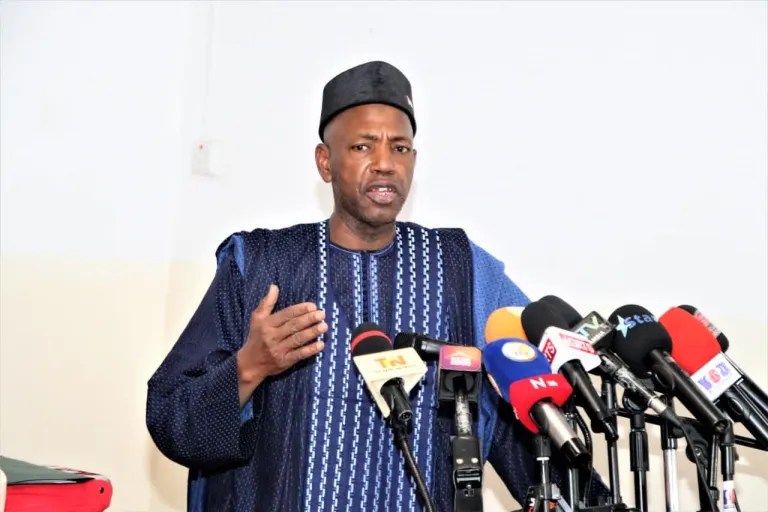
Brikama Area Council (BAC) Chairman Yankuba Darboe has condemned the central government’s handling of local corruption, describing it as a “culture of impunity.” Speaking on QTV, Darboe argued that regulatory constraints strip local councils of disciplinary powers and allow the central body to simply transfer, rather than prosecute, corrupt officials
Chairman of the Brikama Area Council, Yankuba Darboe expressed deep concern over the severe lack of autonomy granted to local councils in handling internal corruption. He explained that current regulations strip local leaders of their disciplinary powers, forcing them to report instances of theft to the Local Government Service Commission.
According to Darboe, this commission routinely treats major financial offenses with a profound lack of seriousness, creating a culture of impunity where corrupt officials get off scot free. He claimed instead of terminating or prosecuting employees caught stealing millions from public funds, the central body merely relocates them to other regions, such as Banjul or Mansakunko. Darboe strongly criticized this strategy of transferring corrupt individuals, arguing that shifting problematic staff to different municipal jurisdictions fails to combat systemic corruption. “Someone you caught red handed steeling millions, is not an individual that you should be transferring to another region,” he said.
Reflecting on the original vision of the local government framework, Darboe noted that the service commissions were intended to be locally based units operating as direct human resource arms for each specific council. He aknowledged under that ideal structure, a council’s establishment committee could report an issue locally, enabling immediate and relevant action. However, he made believe the system was later centralized under the Ministry of Local Government, creating a massive bottleneck where the Brikama Area Council, the Kanifing Municipal Council (KMC), and the Banjul City Council are forced to wait in a single, prolonged queue for the ministry to determine the fate of reported wrongdoers. “Somewhere down the line they centralized everything to the office of the ministry of local government and that makes it very difficult for the councils now,” he said. Darboe asserted that this extreme centralization proves the central government is not genuinely serious about eradicating grass roots public corruption.
The Chairman identified the complete absence of a deterrent factor as the greatest hurdle to maintaining financial integrity within the council. He affirmed even when individuals are caught red handed committing financial crimes, the council must navigate a slow and exhausting bureaucratic process of reporting them to the commission nothing this process happens in a joint hearing where both parties present their arguments, yet the outcome is rarely harsher than a minor one-month suspension or a symbolic slap on the wrist. He attributed this failure to the detachment of the commission’s members, noting that they do not work within the local council environments and only meet occasionally to make binding decisions for numerous municipalities simultaneously. He emphasized that the entire structural framework governing local government operations requires a complete overhaul to restore accountability.
To demonstrate the extent of this institutional friction, Darboe highlighted a severe three month administrative standoff that occurred during the past October when the council completely halted operations. He stressed the council collectively refused to work or sign any official documentation until the central authorities removed their Chief Executive Officer and Finance Director, who had been caught red handed stealing public funds. “We were a Council that went for three months without salary because we refused to work or sign any document unless and until they remove the then CEO,” he said. Darboe alleged that the Minister and the Local Government Service Commission intentionally tried to impose these compromised officials upon the council to act as impediments and lead to their failure. In response, he claimed the council launched a fierce protest, bringing all municipal functions to a complete standstill and declaring that they would not resume work until the corrupt administrative leaders were permanently removed.
He affirmed when he and his administration initially assumed office, they were completely denied access to the council’s bank accounts by officials who claimed the council had no legal right to intervene in accounting matters. Darboe firmly countered this by citing the Local Government Finance and Audit Act, which explicitly mandates that not a single dalasi can be withdrawn from council accounts without council approval noting prior to his tenure, CEOs exercised absolute authority over both approvals and authorizations without the knowledge of elected council members, essentially allowing them to sign off on massive checks for themselves without any oversight. He aknowledged his leadership successfully dismantled this unchecked system by implementing strict spending thresholds that require the Chairman’s direct approval for specific financial tiers, a reform that immediately generated an influx of saved revenue and drastically reduced the council’s deficit.
“We started seeing their accounts yielding up and then getting more money and the deficit started falling,” he said


Discussion