
The United Democratic Party (UDP) is saying it plans to announce its own results in the December 2026 presidential election before the Independent Electoral Commission (IEC) makes the official declaration, raising an important question about the difference between announcing figures collected at polling stations and the legal authority to declare the final election result.
The responsibility of announcing elections is placed on the IEC. Research done by this paper and also interviews with a historian has shown that there has never been an instance in which a political party made an election result announcement before the IEC. The parties would collect their information and then use it in petitions they file before the courts if they are aggrieved with results as announced by IEC. UDP’s executive member Dr Lamin Manneh has announced that his party has taken this position and will announce the results before the IEC. For Manneh, he unequivocally stated that everyone has the right to announce results since the country has adopted the “Counting-On-The-Spot” system. His interpretation is that the IEC only proclaims while the people or the parties could do the announcements of the results. For Manneh, the UDP feels that the past results do not truly reflect the votes and this is why they will now do the announcements before the IEC.
Under Section 43(1) of the 1997 Constitution, the IEC is responsible for the conduct and supervision of public elections and referendums. The constitutional provision states that the Commission “shall be responsible for the conduct and supervision of the registration of voters for all public elections and the conduct and supervision of all public elections and referenda.”
The Elections Act then sets out the process through which election results move from the polling station to the Commission. Section 80 requires a report to be prepared after counting, including the votes obtained by each candidate, while Section 80(4) requires the Commission to display a signed copy of the results at each polling centre for public attention.
But Section 81(2) gives the Commission the responsibility to compile and declare the final result and the candidate elected. It states that: “The Commission shall, as soon as practicable on receipt of election results from the polling centres, compile the results and declare the – (a) final result; and (b) candidate elected.”
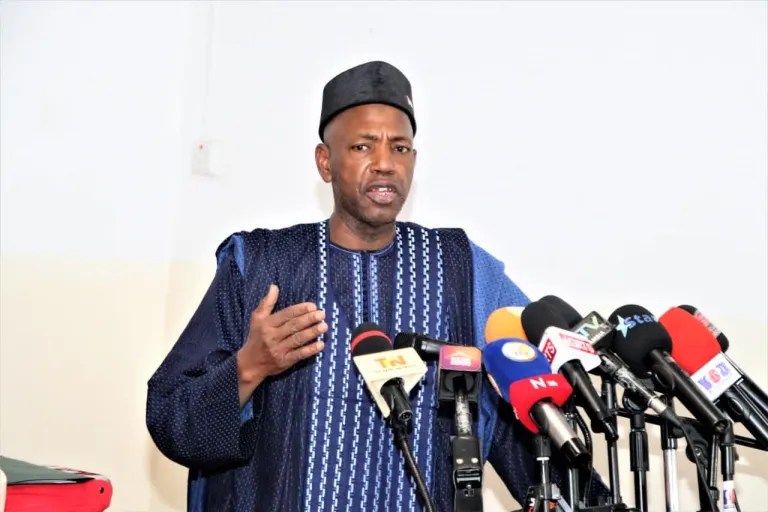
For Dr Lamin Manneh, an executive member of the UDP, his party will collect results from polling stations, enter them into its own system and make them public before the IEC makes its declaration.
“You see this 2026 presidential elections coming, we [UDP] will do the same. We will provide the people with the results before 9 pm, or possibly before 8 am,” Manneh said.
His comments put the question of who has the right to announce election results at the centre of the UDP’s preparations for the December presidential contest. Manneh was speaking from the experience of recent elections in which, he said, the UDP independently collected and announced results before the IEC.
“When we gave our results, it was exactly the same as the one IEC gave. There was no difference of one vote,” he said, referring to the by-election in Masembeh, Kiang Central in the Lower River Region.
He said the party followed the same process during the Kiang Kaiaf by-election, where it lost to the National People’s Party (NPP).
“We lost and we acknowledge that. The results we gave were exactly the same as the ones the IEC announced,” he said.
Manneh said the party deliberately made sure that its figures were released ahead of the IEC’s official announcement.
The UDP’s position is based on what Manneh described as “counting-on-the-spot”.
“The day we agreed to use the ‘Spot Counting’ law as a country was the day everyone has the right to announce elections results,” Manneh said.
“What IEC does is to proclaim, but everyone has the right to announce the results,” he added.
According to Manneh, the UDP will collect results from polling stations and place them into its own system before making the figures available to the public.
“We collect and put it our system; then announce for everyone to know,” he said.
The distinction between counting and declaring the final result is set out in the Elections Act. Section 80(1) provides that, after counting is completed, the Presiding Officer “shall prepare a report on the counting of votes”. The report must include, among other things, “the total number of votes cast per polling station”, “the number of valid votes”, “the number of invalid votes” and “votes obtained by each candidate”.
The law also provides a role for counting agents. Section 80(2) states that the Returning Officer “shall require each counting agent to sign or thumbprint the report on the counting of votes”.
And under Section 80(4), “The Commission shall display a signed copy of the results of the vote at each polling centre outside the polling centre for public attention.”
The next stage is transmission. Section 81(1) states: “On completion of the requirements of section 80, the Returning Officer shall report the results of the elections to the Commission by such means of communication as the Commission may direct.”
Then comes the Commission’s declaration. Section 81(2) states: “The Commission shall, as soon as practicable on receipt of election results from the polling centres, compile the results and declare the – (a) final result; and (b) candidate elected.”
Section 81(3) further provides that the Chairperson or Vice Chairperson shall be the Returning Officers to announce election results, with the Commission empowered to choose another Returning Officer in their absence.
The law also deals with publication. Under Section 82(1), the Commission shall, after the declaration of results, “publish the results of the election or referendum” and retain the ballot tokens and other documents transmitted to it for the period prescribed by law where no petition has been filed.
This creates a clear statutory sequence: counting at the polling station, preparation and signing of the counting report, transmission of the results to the Commission, compilation and declaration of the final result by the Commission, and subsequent publication.
Manneh insisted that the UDP will announce its own figures based on what they collected from their agents.
The 2021 petition
The UDP’s decision to prepare its own results system also comes with the background of the party’s experience after the 2021 presidential election. The UDP lost the 4 December 2021 presidential election to Adama Barrow, who was declared the winner by the IEC.
The party, led by Ousainou Darboe, rejected the outcome and took the matter to the Supreme Court through an election petition. The petition was filed on 14 December 2021, but the Supreme Court did not determine the substantive allegations made by the UDP.. The court dismissed the petition after finding that the UDP had failed to comply with Rule 11 of the Elections Petition Rules.
Rule 11 required the petitioner (UDP) to serve the necessary notice and documents within the prescribed five-day period. The court treated compliance with the rule as mandatory. The Supreme Court therefore did not go into the substance of the UDP’s allegations about the 2021 presidential election.
The UDP’s 2021 petition instead ended on a procedural issue. The Supreme Court held that compliance with Rule 11 was mandatory and that non-compliance was fatal to the petition. Darboe subsequently maintained that the party had not lost on the merits.
“We have not lost anything because the petition was not dismissed based on merit but a mere technicality,” Ousainou Darboe said at the time.
A different approach in 2026
Five years later, the UDP is preparing for another presidential election with a different approach to the handling of results. Rather than waiting for the IEC’s final declaration, Manneh said the party intends to publish its own figures based on results collected from polling stations.
The Elections Act provides for the preparation of a report on the counting of votes at the polling station. The report includes the votes obtained by each candidate, valid and invalid votes and other information relating to the count. A signed copy of the results is to be displayed at the polling centre.The law then provides that the Returning Officer transmits the results to the Commission, which compiles them and declares the final result and the candidate elected.
Manneh said the UDP will operate its own system alongside that process.
The Guinea example
The idea of a political party or candidate announcing election results before the official electoral authority is not without precedent in West Africa.
In Guinea’s 2020 presidential election, opposition leader Cellou Dalein Diallo declared himself the winner before the official results had been announced.
On 19 October 2020, a day after voting, Diallo said that, based on information gathered by his Union of Democratic Forces of Guinea, he had won the election.
“Despite all the anomalies of this election and in view of the results that came out of the polls, I emerge victorious from this presidential election,” Diallo said.
The Guinean electoral commission had not yet announced the official result when Diallo made his declaration. When the official results were announced the electoral commission, Diallo lost. He fought back by filing a petition, yet, he lost his legal challenge seeking to nullify the results
For Manneh, his party’s announcements are going to be based on what is collected from the polling centers by the agents. Manneh pointed to the party’s experience in Kiang Central and Kiang Kaiaf as evidence that its system can produce figures matching those of the electoral commission.
“When we announced our results, it was exactly the same as the one IEC gave. There was no difference of one vote,” he said.
He made the same point about Kiang Kaiaf, even though the UDP lost the contest.
“We lost and acknowledged that. The results we gave were exactly the same as the one the IEC announced,” he said.
That example is important to the UDP’s argument because the party is not presenting independent publication of results simply as a method for declaring victory. Manneh said UDP is prepared to announce results using their system.
The party’s proposed system therefore appears to be aimed at establishing an independent set of results alongside the IEC’s official process.
“We collect and put it our system; then announce for everyone to know,” Manneh said.
The question is does a party have the mandate to announce results. For Manneh, everyone has the right to do that since the country uses “counting-on-the-spot.”
The discussion has also moved beyond political parties.
The Chief Executive Officer of Kerr Fatou Media Platform, Fatou Touray, supported the view that election results can be announced before the IEC. She said her media organisation also announced results before the electoral commission. But she added a qualification: after publishing the figures, her media house would tell its audience and readers to wait for the official announcement from the IEC. She even stated that her predicted the victory of Rohey Malick Lowe
That distinction separates the publication of results from the formal declaration of the winner.
Under Section 81(2) of the Elections Act, the Commission is required to compile the results and declare the “final result” and the “candidate elected”.
Under Section 82(1), the Commission is then required, after the declaration, to publish the election results. For the UDP, however, the results announced by the party would be based on information collected directly from polling stations.
“The day we agreed to use the ‘Spot Counting’ law, was the day everyone has the right to announce elections results,” Manneh said.
The UDP’s announcement comes as political parties prepare for the December 2026 presidential election. The party has already experienced the consequences of an election dispute reaching the Supreme Court. Its 2021 petition was filed after it rejected the outcome of the presidential election, but the court ultimately struck it out because of the failure to comply with Rule 11. In 2026, Manneh said the party wants to have its own results ready before the IEC makes its declaration.
“You see this 2026 presidential elections coming, we [UDP] will do the same,” he said.
“We will provide the people with the results before 9 pm, or possibly before 8 am,” he added.
The proposed timing would place the UDP’s announcement ahead of the IEC’s official proclamation, depending on how quickly results are received and processed.
Manneh said the party’s system would collect the figures, enter them and make them available to the public.
“We collect and put it our system; then announce for everyone to know,” he said.
The Elections Act, meanwhile, provides that the Returning Officer reports the results to the Commission and that the Commission compiles the results and declares the final result and the candidate elected.
As the 2026 presidential election approaches, the UDP is therefore preparing not only to contest the votes at the polling stations, but also to operate its own results-gathering and reporting system. And Manneh has already given the party’s proposed timetable.
“We will provide the people with the results before 9 pm, or possibly before 8 am,” he said.


Discussion