
The acceptance of Talib Ahmed Bensouda’s presidential nomination by the Independent Electoral Commission (IEC) has become one of the defining democratic moments of The Gambia’s 2026 election cycle.
Despite widespread speculation that the White Paper on the Local Government Commission of Inquiry could exclude a major opposition challenger, the constitutional process produced a different outcome.
The episode raises a central question: Can a leader credibly be described as authoritarian when one of his strongest political opponents remains free to contest, campaign, criticize, and seek power through the ballot box?
In contemporary African politics, accusations of dictatorship have become increasingly common. Every incumbent facing a competitive election is eventually accused of attempting to manipulate institutions, silence opponents, or tilt the political field in his favor. Yet constitutional democracies cannot be judged by suspicion alone.
Institutions, evidence, conduct, and outcomes must do the judging. The Independent Electoral Commission’s recent acceptance of Talib Ahmed Bensouda’s presidential nomination provides a clear democratic test.
For weeks, public discourse focused on whether the Government White Paper arising from the Local Government Commission of Inquiry would ultimately prevent Bensouda from contesting the December 5, 2026 presidential election.
Concerns spread across opposition circles, legal communities, legal vultures, the legal carpenters fraternity, and civil society organisations that constitutional eligibility provisions might be interpreted in a way that would remove a significant challenger from the race.
The controversy evolved into a broader national conversation about democratic governance, institutional independence, and the limits of executive authority. Yet democracy is not judged by speculation. Outcomes judge it. And the outcome is clear.
The IEC reviewed Talib Ahmed Bensouda’s nomination papers and accepted them. One of the incumbent government’s most prominent opponents remains on the ballot.
He remains free to campaign, criticise government policies, mobilize supporters, and ask Gambians to entrust him with the presidency. That reality deserves careful reflection, especially in light of President Adama Barrow’s reported response.
According to public reports on November 5, 2025, President Barrow acknowledged that questions about the legal effect of the White Paper and the constitutional eligibility of presidential candidates fall within the IEC’s authority and, ultimately, the courts’.
He reportedly emphasised that the White Paper itself was neither a judicial decision nor the institution responsible for determining presidential eligibility. This is a constitutionally significant distinction.
President Adama Barrow’s office argues that publishing the Commission’s report and the accompanying White Paper was a constitutional obligation. State House maintains that Section 203(a) of the Constitution required publication within six months of receiving the report and that the Government acted within the prescribed deadline.
The response also emphasises that Bensouda has already appealed the Commission’s adverse findings to the Court of Appeal. According to State House, the validity and effect of those findings are now matters for judicial determination, making it inappropriate for the Executive to offer further interpretation while proceedings are pending.
A central feature of the Government’s argument is its distinction between the Commission’s findings and the White Paper itself. State House insists that the White Paper merely outlines the Government’s position on the report and does not constitute a judicial ruling or determine any person’s eligibility to contest public office.
The letter further distances the Government from decisions concerning presidential qualification, stressing that such matters fall within the constitutional mandate of the Independent Electoral Commission and, ultimately, the courts.

In many political systems, executives attempt to extend their influence into areas reserved for independent institutions. Constitutional democracy operates differently.
The rule of law requires allocating powers according to constitutional mandate rather than political convenience. Whether one agrees with the President politically is beside the point. The important issue is institutional restraint.
The Constitution allocates powers to institutions, not individuals. The constitutional framework establishes separate functions for the Executive, Legislature, Judiciary, and the Independent Electoral Commission.
By publicly recognising those constitutional boundaries, Barrow appeared to acknowledge the limits of executive authority rather than assert its supremacy. That matters.
A genuinely authoritarian leader rarely entrusts his political future to institutions he cannot entirely control. The key issue in the Talib Ahmed Bensouda controversy is whether constitutional institutions were ultimately allowed to perform their respective functions.
Across Africa, democratic backsliding has often occurred not through military coups alone, but through the gradual politicization of institutions that should act independently.
In several countries, opposition leaders have found themselves entangled in judicial proceedings, administrative disqualifications, constitutional reinterpretations, selective prosecutions, or electoral rulings that effectively remove them from competition before voters can render a verdict. For this reason, allegations of interference in constitutional processes must always be treated seriously.
During the debate over Bensouda’s eligibility, allegations arose that Attorney General and Minister of Justice Dawda Jallow attempted to influence the IEC or advised actions that could block Bensouda’s candidacy.
“Talib has made a serious claim, asserting that Justice Minister Dawda Jallow was repeatedly moving between the Independent Electoral Commission (IEC) and State House. Given the IEC’s intended independence, why would the Justice Minister intervene just days before the December 5th election? Is the government attempting to sway the outcome?” according to a Pulse Gambia TV report on November 2, 2026.

Opposition figures and Coalition 2026 representatives publicly raised these allegations, while public reporting noted that they were not independently verified. Both Dawda Jallow and Information Minister Ismaila Ceesay publicly rejected the accusations.
The Attorney General reportedly denied ever visiting the IEC in connection with the matter. At the same time, Dr. Ceesay challenged those making the allegations to provide evidence and maintained that neither the Attorney General nor President Barrow had interfered in the Commission’s work.
Reasonable people may hold different political opinions regarding these denials, but constitutional analysis requires more than political suspicion. It requires attention to evidence and outcomes.
Most importantly, the legal questions arising from the Local Government Commission of Inquiry remained subject to judicial consideration.
The electoral questions remained within the IEC’s constitutional jurisdiction. Neither the Presidency nor the White Paper became the final arbiter of eligibility. Instead, the constitutional process ran its course.
The courts continued to exercise their judicial function. The IEC continued to exercise its electoral mandate. And ultimately, the IEC accepted Talib Ahmed Bensouda’s nomination papers and cleared him to contest the presidential election. That outcome is significant.
If the objective had been to weaponize executive authority, the justice system, or electoral administration to remove a political rival from competition, the controversy would likely have ended with exclusion. Instead, it ended with participation.
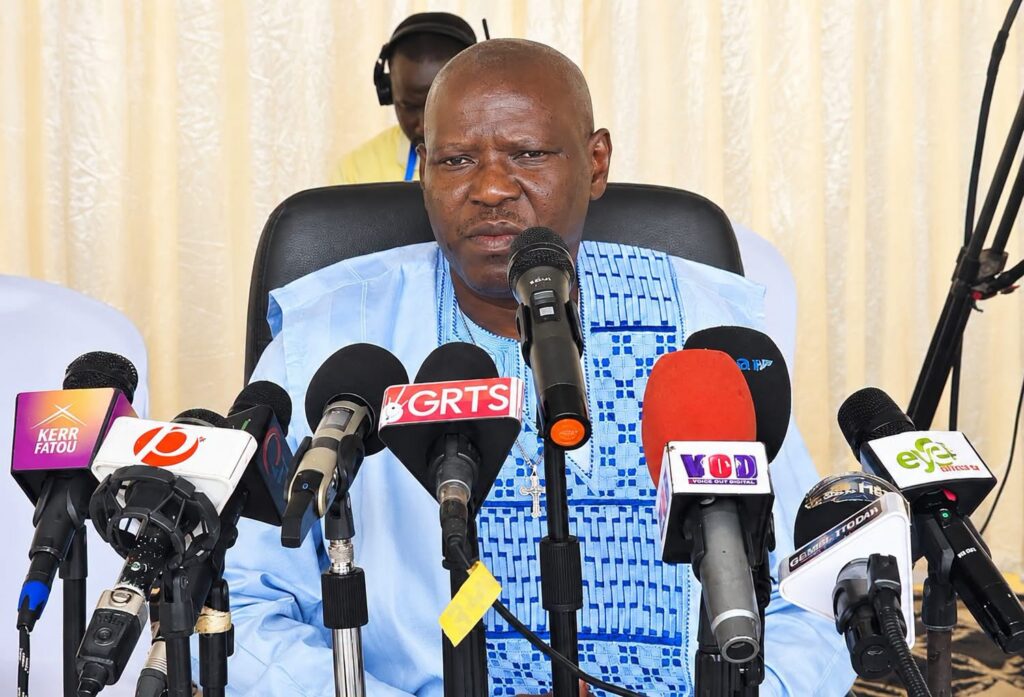
And in democratic politics, that distinction matters profoundly.
Throughout political history, authoritarian tendencies have often revealed themselves through the manipulation of courts, electoral institutions, constitutional provisions, and administrative processes designed to reduce political competition.
The methods may differ. The objective remains remarkably similar. Reduce uncertainty. Control competition. Shape outcomes before voters have an opportunity to decide.
If President Barrow truly intended to prevent Talib Ahmed Bensouda from contesting the presidency, the controversy surrounding the White Paper would have offered an opportunity to pursue that objective.
Instead, Bensouda remains on the ballot. That is not proof of democratic perfection. It is, however, evidence against a narrative of deliberate exclusion and against the dictatorship claim.
The role of the IEC is equally important. The Commission operated under extraordinary public scrutiny. Every interpretation, decision, and procedural step carried political implications.
Nevertheless, the institution performed its constitutional mandate and reached its own determination regarding the nomination process.
In democracies, confidence grows when institutions can perform their functions without political intimidation from incumbents or opposition actors.
The National Human Rights Commission also entered the conversation, emphasising the importance of constitutional procedures and institutional responsibility.
The Commission specifically stated that it would not prejudge matters that properly fell within the mandate of other constitutional institutions.
The broader lesson from this episode is that institutions, not political passions, must remain the guardians of democratic legitimacy.
One of the strongest arguments against the dictatorship narrative is not found in government press releases or ministerial statements. It lies in the continued functioning of constitutional institutions, particularly the courts. The Gambian constitutional order is based on separation of powers and judicial independence.

Legal scholars and constitutional commentators have long emphasized that the Judiciary serves as an independent pillar of democratic governance.
Judicial independence is not measured by how often governments win cases. It is measured by whether governments can lose them.
Throughout democratic systems, courts occasionally rule against those in power.
Adverse rulings against public authorities often show that courts can exercise independent judgment. The more important democratic question is whether governments respect those decisions.
A government that continues operating within a legal system capable of ruling against it demonstrates a degree of constitutional maturity rarely associated with authoritarianism.
The true test of commitment to the rule of law is not whether government wins legal disputes. It is whether government respects the legal system when it does not.
History offers additional perspective. Many Gambians remember periods when criticism of government carried significant personal and political risks. Those memories remain an essential part of the nation’s democratic consciousness. The Gambia today is not without imperfections, far from it.
Yet opposition parties campaign openly. Political leaders criticize the President. Journalists question official decisions. Civil society organisations challenge government policies. Constitutional disputes are litigated in public view.
Indeed, many of the criticisms directed at President Barrow are themselves evidence of a political space broader than that which existed during previous authoritarian periods. Recognising this reality does not require support for the government. It requires only an honest recognition of democratic progress.
Political scientists often describe democracy as a system built upon uncertainty. Authoritarian systems seek certainty. Democratic systems accept uncertainty. Authoritarian leaders prefer predetermined outcomes.
Democratic leaders must accept the possibility of defeat.
This is why accepting Talib Ahmed Bensouda’s nomination matters beyond one candidate. It preserves uncertainty. It preserves competition. It preserves voter choice. The election remains open. The voters remain sovereign. No institution has predetermined the outcome. And because uncertainty survives, democracy survives.
The enduring lesson of the Talib Ahmed Bensouda controversy is not ultimately about Talib Bensouda. Nor is it solely about President Adama Barrow. It is about whether constitutional institutions rather than political power determine the rules of democratic competition.
The evidence presently before the nation suggests that they do. A candidate many believed would be excluded remains on the ballot. The IEC exercised its constitutional mandate. The courts remain available to adjudicate disputes. Public debate flourishes. The media remains active. The opposition remains competitive.

At a time when courts, electoral commissions, and prosecutorial powers have been accused in some African countries of being used to narrow democratic competition, the Gambian experience in the Talib Bensouda controversy points toward a different conclusion: constitutional institutions, rather than executive decree, ultimately determined the outcome. This does not place any government above criticism. Nor should it.
Democracy requires scrutiny. But scrutiny must remain anchored in evidence. On the central accusation that the machinery of state would be used to prevent a major political challenger from contesting the presidency, the facts presently available point elsewhere.
Talib Ahmed Bensouda remains a candidate for President. That fact affirms a constitutional principle larger than any president, opposition leader, political party, or election cycle:
Governments do not choose their opponents. Independent institutions apply the law. Citizens choose their leaders. And on December 5, 2026, the final verdict will belong not to the executive branch, not to political speculation, and not to partisan narratives.
It will belong to the sovereign people of The Gambia. That is not the language of dictatorship. It is the essence of democracy itself.
By Alagi Yorro Jallow

About the Author
Alagi Yorro Jallow is an emeritus journalist, author, communication specialist, and public affairs commentator. He writes regularly on governance, democracy, constitutionalism, media ethics, public policy, and African political development.




Discussion