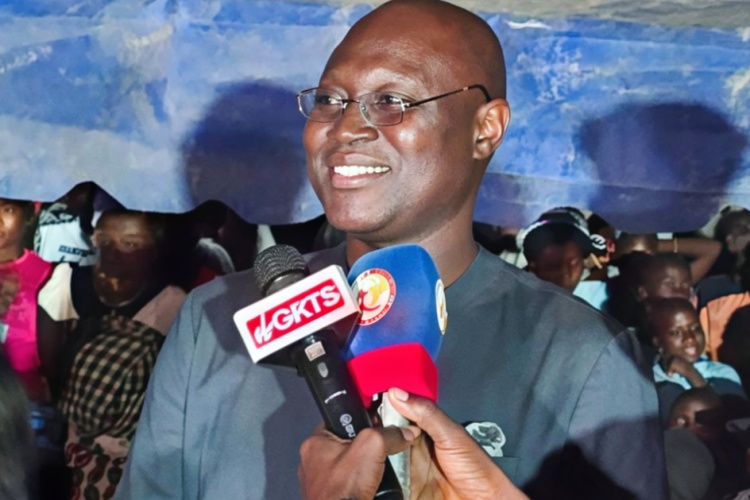
The Minister of Basic and Secondary Education, Dr. Habibatou Drammeh, has defended the performance of Gambian students in the 2026 West African Senior School Certificate Examination (WASSCE), saying the results reflect progress from previous years and the impact of reforms being implemented by the Ministry.
Speaking at a press conference following the release of the 2026 WASSCE results, Dr. Drammeh outlined what she described as the Ministry’s sustained efforts to improve the quality of education and student outcomes across the country.
The Minister said the government and education stakeholders have been working to strengthen teaching and learning, improve the learning environment and address challenges affecting students’ academic performance.
The 2026 performance data, however, presents a mixed picture.According to the statistics, 12.1 percent of candidates obtained zero passes, while 12.8 percent obtained one pass. A further 10.7 percent secured two passes, 9.2 percent obtained three passes, and 8.6 percent obtained four passes.
At the higher end of the performance scale, 8.7 percent obtained five passes, 9.0 percent obtained six passes, 9.4 percent obtained seven passes, 10.0 percent obtained eight passes, while 9.4 percent obtained nine passes.
The figures also show continued challenges around the critical combination of English Language and Mathematics. The statistics presented by the Ministry indicate that the proportion of candidates meeting the required credit benchmark, particularly when English and Mathematics are included, remains a key area of concern.
Despite the concerns, Dr. Drammeh maintained that the overall trend should be assessed against previous years and the reforms introduced by the Ministry rather than focusing solely on individual indicators.
WAEC also reported that 98 candidates from 13 schools had their results withheld over suspected examination malpractice pending consideration by the Council’s appropriate committee. The Council further noted that incomplete records were still being processed and that the statistics could change once those records are completed.
The Minister reaffirmed the Ministry’s zero-tolerance policy towards examination malpractice, stressing that the integrity of the examination system must be protected. She said the authorities would continue to take measures against candidates, schools or individuals found to be involved in examination malpractice, emphasizing that academic success must be achieved through genuine effort and learning.
Dr. Drammeh further called on parents and guardians to play a greater role in supporting teachers and the Ministry in improving students’ learning outcomes.She urged parents to work closely with schools, monitor their children’s academic progress and create an environment that encourages students to take their studies seriously.
According to the Minister, improving educational outcomes is a collective responsibility that requires the involvement of government, teachers, parents, students and the wider community.
Meanwhile, Mansa Colley Bojang Senior Secondary School emerged as the top-performing school in the 2026 WASSCE results. The Minister, however, rejected suggestions that private schools are inherently superior to public schools in academic performance.
She argued that both public and private schools operate under the same national curriculum, while differences in teacher capacity between the two sectors are relatively limited.
Dr. Drammeh pointed to the overall ranking of top-performing schools as evidence, noting that 16 of the top 25 performing schools are public schools.
The results, she suggested, demonstrate that strong academic performance is not exclusively linked to whether a school is public or private, but is influenced by a combination of factors including teaching, school leadership, student commitment, parental support and the learning environment.
While the 2026 WASSCE figures continue to raise questions about the country’s education outcomes, particularly the number of students recording few or no passes, the Ministry is maintaining that the reforms currently being implemented are beginning to produce progress.
The challenge now remains whether those improvements can be sustained and translated into stronger performance, particularly in core subjects such as English Language and Mathematics, in subsequent examinations.


Discussion