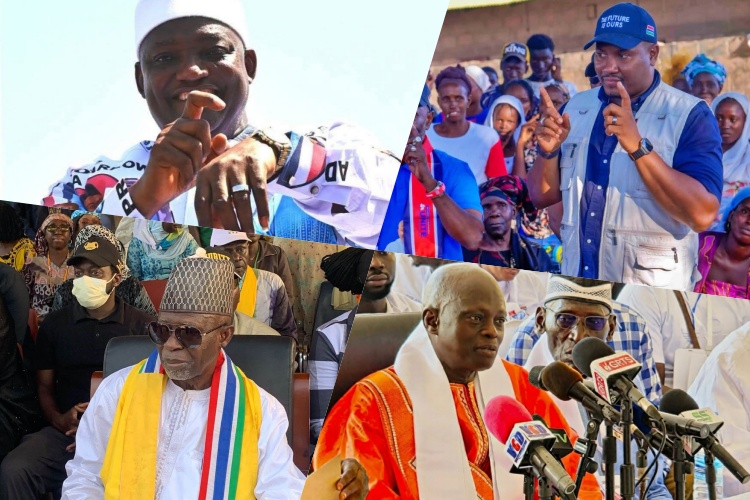
Gambiaj.com – (BANJUL, THE GAMBIA) – With the December 5 presidential election approaching, candidates are intensifying their campaigns across the country, presenting competing visions on development, governance, constitutional reform, and national leadership.
From promises of major infrastructure investments to calls for institutional change and political renewal, the campaign trail is increasingly becoming a platform for candidates to make their case to voters.
Barrow Promises Basse Dry Port as He Seeks Third Term
President Adama Barrow has pledged to establish a dry port in Basse, Upper River Region, as part of plans to transform the town into a major commercial hub if re-elected for a third term.
Addressing supporters during a campaign meeting in Basse, the National People’s Party (NPP)-led alliance candidate said a contract had already been signed for the proposed facility, which he believes would attract goods from neighboring countries, including Mali, Guinea-Bissau, and Guinea-Conakry.
Barrow said the project, alongside the new port under construction in Sanyang, forms part of his government’s broader infrastructure and development agenda.
He challenged opposition candidates to explain what they would offer Gambians, arguing that his administration had already made progress in road construction, water supply, education, healthcare, and electricity.
Describing opposition candidates as his “apprentices,” Barrow urged voters to support continuity, presenting the December 5 election as a choice between maintaining ongoing development projects and reversing the progress achieved under his administration.
He also interpreted the turnout in Basse as evidence of strong support for his re-election bid, naming several constituencies in the Upper River Region that he said were ready for the polls.
Bensouda Presents Business and Municipal Experience as Leadership Credentials
Coalition 2026 candidate Talib Ahmed Bensouda is making his experience in the private sector and local government a central part of his presidential campaign, arguing that his professional background has prepared him to address the country’s economic and governance challenges.
Speaking to journalists, the former Kanifing Municipal Council mayor said his years as an employee in the private sector, entrepreneur, and local government leader had exposed him to the difficulties confronting businesses, workers, and public institutions.
He cited foreign exchange constraints, high energy costs, and market instability as challenges he had experienced firsthand in business, while his time at the municipal council had given him practical knowledge of public administration and service delivery.
During campaign meetings in Sare Sofie, Dobong, and Galleh Manda, Bensouda also criticized the government’s development record, questioning the quality of roads, healthcare, and electricity provision.
“What President Barrow cannot do in 10 years, he cannot do in 15 years,” he told supporters.
In Sare Sofie, he questioned why residents had continued to experience poor road conditions despite previous development promises, including Barrow’s pledge to transform the area into a Dubai-like community.
Bensouda argued that development should not be measured solely by infrastructure projects but also by improvements in people’s daily lives, including access to functioning healthcare facilities, qualified medical personnel, essential medicines, and reliable electricity.
He pledged to replicate and expand initiatives introduced during his tenure as KMC mayor across the country’s regions if elected president.
Darboe Calls for National Healing and Accountability
United Democratic Party (UDP) leader and Gambia First Coalition presidential candidate Ousainou Darboe has urged Gambians to use the December 5 election to address what he described as a longstanding national wound dating back to 1996.
Addressing supporters in Diabugu Batapa, Upper River Region, Darboe framed the election as an opportunity for national recovery, encouraging voters to carefully assess the sincerity, experience, and competence of those seeking the presidency.
He drew comparisons between his background and that of incumbent President Adama Barrow, arguing that effective leadership requires education, administrative experience, and the ability to honor campaign commitments.
The opposition leader attributed the country’s economic difficulties to what he described as shortcomings in the current administration’s leadership, accusing Barrow of failing to fulfill promises made over the past decade.
Darboe also raised concerns about the management of natural resources in the Upper River Region, alleging that foreign involvement in the fishing sector had contributed to declining fish stocks and reduced access for Gambian fishermen.
He further criticized previous market clearances in the Greater Banjul Area, arguing that the deployment of security personnel to remove trading stalls had negatively affected women vendors and places of worship without delivering the promised development projects.
He urged voters to prioritize compassion for vulnerable communities and accountability when choosing their next president.
Lamin J. Darboe Promises One-Term Presidency And Constitutional Limits
Team Gambia Grand Coalition presidential candidate Lamin J. Darboe has made presidential term limits a central feature of his campaign, pledging that his coalition would serve only one five-year term if elected.
Addressing supporters in Wuli Welingara Yareh, he said his administration would use its time in office to introduce legislation limiting presidents to a maximum of two five-year terms.
“We will serve only five years when we win. In those five years, we will make laws, and that law is that Gambia’s president will no more exceed ten years,” he said.
Darboe argued that prolonged presidential rule had contributed to the country’s governance challenges, criticizing what he described as a tendency among political leaders to remain in power for extended periods.
He said The Gambia had had only three presidents in 61 years, with previous leaders spending more than two decades in office.
The candidate also criticized Barrow’s decade in power, arguing that constitutional safeguards were necessary to prevent excessive concentration of political authority.
He presented the proposed reforms as part of a broader commitment to good governance, insisting that national development depends on the quality of leadership and the strength of democratic institutions.
Isatou Touray Makes New Constitution A Campaign Priority
Independent presidential candidate and former Vice President Isatou Touray has pledged to prioritize the adoption of a new constitution if elected in December.
Speaking to supporters in Jattaba and Kiang Jiffarong, Touray argued that The Gambia cannot fully enter a new democratic era without replacing the existing constitutional framework.
“We are only talking, but there is no democracy because democracy requires us to ensure that we have a constitution that guides the governance and development of a country,” she said.
The former Vice President maintained that constitutional and political reforms would be central to her administration, arguing that a strong constitutional framework is essential for democratic governance and national development.
Touray also presented her candidacy as a peaceful route to political change, urging Gambians to exercise their democratic rights through the ballot box rather than resorting to violence.
“I am coming here to seek power, to seek your votes, and to tell you that, to address the problems that we have, we have to work hard to do it in a non-violent way,” she told supporters.
She said she had consistently advocated peaceful democratic change since 2016 and called on voters to protect the country’s integrity and democratic future.
Almameh Gibba’s Campaign Gets An Unexpected Newborn Namesake
For No To Alliance Movement presidential candidate Almameh Gibba, a campaign stop in Niamina Pacharr produced an unexpected moment of public affection when a couple named their newborn baby after him.
According to Sadibou Bajakarr Badjie, the movement’s Media Director, the couple stopped Gibba’s campaign convoy to welcome the presidential aspirant and introduce their newborn, whom they had named in his honor.
Gibba was reportedly surprised and delighted by the gesture, as villagers expressed their admiration and pledged support for his presidential bid ahead of the December 5 election.
The episode offered a personal moment during the campaign tour, illustrating how political support can sometimes be expressed through gestures that extend beyond speeches and rallies.
The movement described the encounter as a demonstration of affection and solidarity, while its campaign caravan continued its tour of the country.


Discussion