
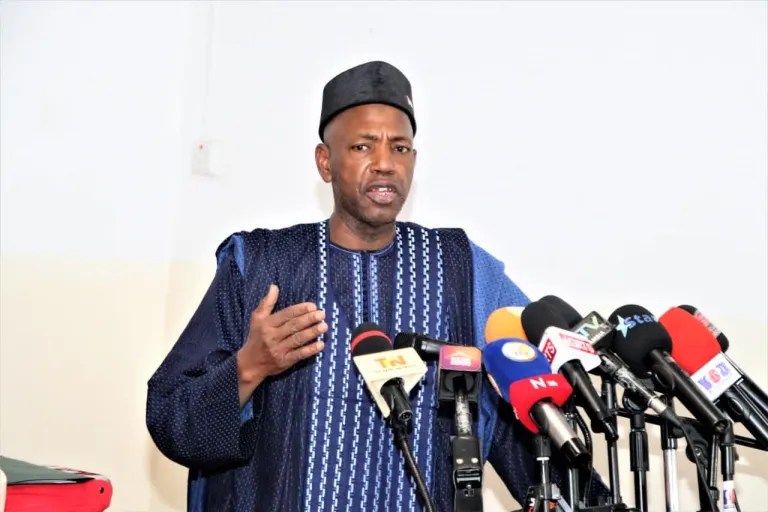
GFF presidential candidate Colonel Musa M. Balla Jammeh has unveiled an ambitious seven-pillar agenda aimed at reshaping Gambian football through stronger governance, modern infrastructure, sustainable financing, elite performance, youth development and the expansion of women’s football. The focus of this article is pillars 1 to 4. The other pillars were published earlier this week.
In his 2026 manifesto, titled “Rising to the Challenge: A Blueprint for Professional and Sustainable Football,” Colonel Jammeh presents his campaign as a plan to move Gambian football towards a more professional, transparent and inclusive future. The GFF elections is taking place this weekend.
The first four pillars of the manifesto focus on the foundations of the game: governance and integrity; infrastructure and finance; elite performance and player welfare; and the development of youth, grassroots and women’s football.
Pillar One: Governance, Integrity and Strategic Partnership
At the heart of Colonel Jammeh’s agenda is a promise to strengthen trust in football administration through transparency, accountability and institutional integrity.
Under the first pillar, his administration would promote compliance with national and international football regulations while strengthening financial management, procurement, competition administration and decision-making.
The manifesto also promises to protect merit, fairness and institutional independence while building confidence among clubs, players, officials, sponsors, supporters and development partners.
Colonel Jammeh also places strong emphasis on improving relations between the Gambia Football Federation and the Government, particularly the Ministry of Youth and Sports, while maintaining the autonomy of the Federation.
The proposed approach seeks greater consultation and cooperation to support national teams and reduce friction between football authorities and government institutions.
Beyond The Gambia, the manifesto sets out plans to strengthen football diplomacy and international partnerships with FIFA, CAF, regional football bodies, member associations and development partners.
These partnerships, according to the manifesto, would support technical cooperation, investment, exchange programmes and opportunities for Gambian players, coaches, referees and administrators.
The first pillar also gives attention to refereeing, safety and integrity, with proposals for continuous referee education, technical assessment, fitness development and mentorship, alongside stronger stadium operations, crowd management, safeguarding and disciplinary systems.
Pillar Two: Building the Football Economy
Colonel Jammeh’s second pillar focuses on infrastructure, commercialisation and sustainable finance.
One of its flagship proposals is the development of a standard mini-stadium in every administrative region of The Gambia, giving regional communities greater access to modern facilities capable of hosting league matches, youth competitions and community football programmes.
The agenda also includes the rehabilitation and modernisation of existing stadiums, training grounds and community pitches, with attention to CAF standards and climate-resilient infrastructure.
The manifesto further presents football as an industry with the potential to generate greater economic opportunities.
It proposes stronger marketing, branding, broadcasting and sponsorship arrangements, while embracing digital systems for football administration, competition management, player registration, data management and fan engagement.
The candidate also intends to promote partnerships with the private sector, development partners and the Gambian diaspora to attract investment and unlock new commercial opportunities for the game.
On financing, the blueprint promises to diversify revenue sources and reduce dependence on traditional funding. The goal is to create a financially resilient football system capable of supporting grassroots football, youth development, women’s football, clubs, refereeing, coaching and national teams.
Pillar Three: Raising Performance and Protecting Players
The third pillar focuses on elite performance, technical excellence and player welfare.
The manifesto promises to build a stronger high-performance culture across all national teams through improved technical planning, talent identification, player development and competition preparation.
It also proposes modern performance analysis and structured long-term programmes to create clearer pathways from youth football to the senior national teams.
Coaching and technical development are also central to the agenda.
Colonel Jammeh’s manifesto proposes increased investment in coach education, sports science, modern coaching methods, performance analysis and sports technology to equip Gambian coaches and technical personnel with the tools required for the modern game.
Player welfare forms another major part of the pillar, with commitments to strengthen football medicine, injury prevention, rehabilitation, nutrition, mental well-being and safeguarding.
The manifesto states that players should be able to develop and compete in safe and supportive environments with appropriate protection and medical support, regardless of age or gender.
The plan also seeks to strengthen domestic football through improved league structures, club licensing and competition standards, while supporting clubs to become more professionally managed, financially sustainable and commercially attractive.
Stronger leagues, the manifesto argues, will provide the foundation for player development and national team success.
Pillar Four: Putting Youth and Women at the Centre
The fourth pillar places young people, grassroots football and women’s football at the centre of Gambian football’s future.
Colonel Jammeh proposes a structured national development pathway covering different age categories, supported by organised competitions, talent identification programmes and accredited academies operating under clear technical standards.
The programme would involve stronger cooperation with regional football associations, schools, academies, clubs and communities, while giving particular attention to underserved communities.
Education is also a major component of the plan.
The manifesto proposes stronger links between football and schools, including school competitions, football scholarships and programmes designed to balance academic development with sporting excellence.
It also promises investment in grassroots coaches, physical education teachers and youth development personnel, while creating opportunities for young people to participate in coaching, refereeing, administration and football governance.
Women’s football is presented as a strategic priority, with a commitment to create greater opportunities for girls and women to participate, compete, lead and succeed.
The programme includes expanding girls’ football in schools and communities, strengthening women’s leagues and competitions, improving pathways to national teams and investing in coaching, refereeing, sports medicine, player welfare and technical development.
The manifesto also seeks to increase the participation of women in football leadership and decision-making through leadership development, mentorship and opportunities to serve as administrators, coaches, officials and executives.
For Colonel Musa M. Balla Jammeh, the four pillars represent the beginning of a broader programme to build a more professional, financially sustainable and inclusive football system. His message is clear: Gambian football must be prepared for a new era.


Discussion