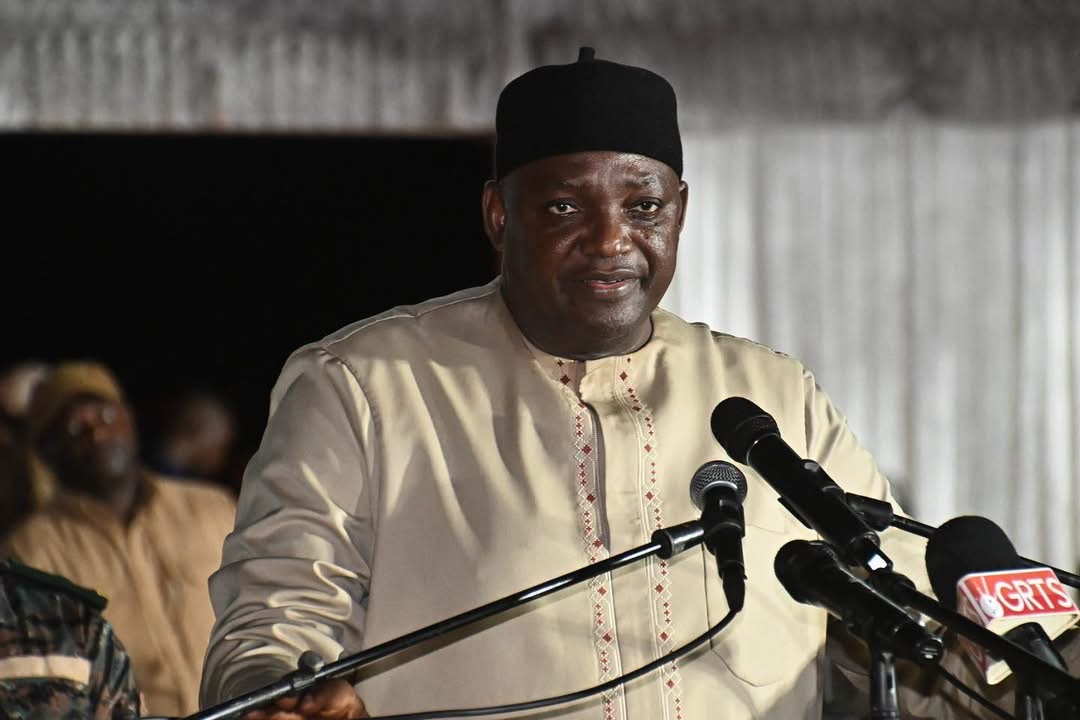
President Adama Barrow has said that his government will deliver a new constitution for The Gambia if it secures an absolute majority in the National Assembly, arguing that the lack of sufficient parliamentary support has hindered previous attempts at constitutional reform.
Speaking in an interview with QTV, Barrow maintained that his government initiated the constitutional reform process and rejected accusations that he was responsible for blocking the proposed constitution.
“If my party has an absolute majority, I can guarantee that the country will have a new constitution,” he said.
The President argued that passing a new constitution would remain difficult without an absolute majority in the National Assembly, where lawmakers vote independently.
Barrow said constitutional reform requires consensus among political parties, warning that the process would fail if each party insisted on its own demands while rejecting those of others.
“There should be a consensus in a constitutional reform, but when each party is trying to force what they want in the constitution while rejecting others’ demands, it wouldn’t work out,” he said.
He maintained that the proposed reforms contained significant discrepancies and recalled that the first attempt to table the constitution at the National Assembly failed when his party had no representation in Parliament.
According to Barrow, the second attempt also failed despite his party holding the majority of seats, because it lacked an absolute majority and opposition lawmakers voted against the proposed document.
The President specifically criticised the United Democratic Party (UDP), claiming its lawmakers voted against the constitution.
He questioned why his government was being blamed for the document’s rejection without equal attention being given to opposition lawmakers who opposed it.
Barrow argued that securing sufficient parliamentary support would be essential to advancing constitutional reform and said that, left to his government alone, the proposed constitution would have been taken to a national referendum.
His remarks place renewed focus on the role of parliamentary arithmetic and political consensus in determining whether The Gambia can secure a new constitution.
By Adama Makasuba



Discussion